T I T O V K A
24 January 1942 · 11:40
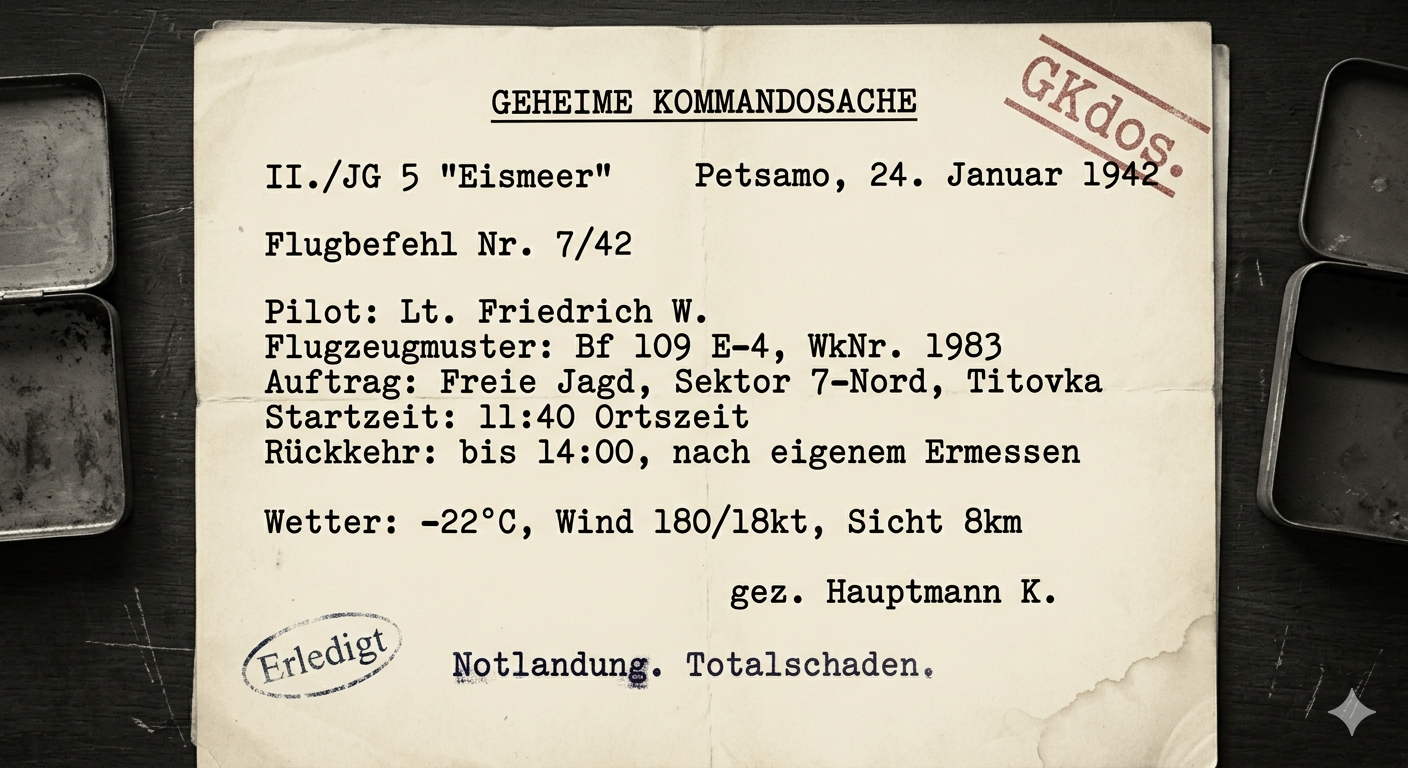
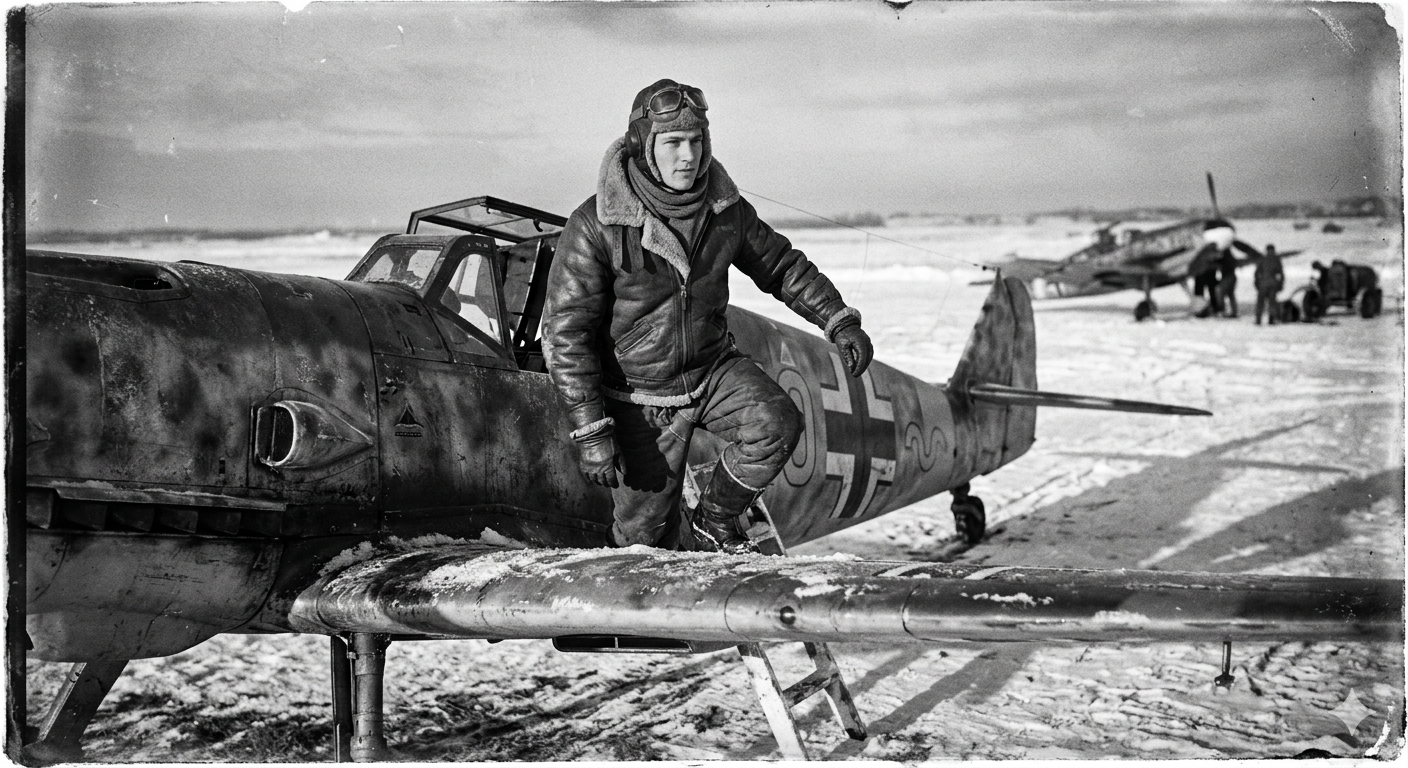
The Daimler-Benz six-oh-one started rough.
It always did in this cold. Minus twenty-two degrees, and the engine needed three minutes longer than the manual said. Friedrich knew the sound — the hesitant waking, the quiet protest of metal that did not want to.
He did not want to either.
He taxied. Snow flew from the undercarriage. The aircraft lifted off at eleven forty-two.
Sector Seven North. Free hunt. Titovka.
Two minutes.
He flew low over the river. Below him: ice. White and grey and flat to the horizon, the kind of landscape that tolerates no differences. Everything the same. Everything still.
Then he saw it.
Not from above. From below.
From the depths of the ice — a shadow. Slow. Unhurried. As if it had time. As if it had always had time.
It looked at him.
I know, thought Friedrich. Not in words. In the knowledge that is older than language.
I know.
Then: tack. tack. tack. tack. tack.
Five impacts. Precise. Cold. A fighter that had flown low over the ice — invisible against the white, a shadow beneath a shadow — had found him before he could see it.
The cooling line.
He smelled it first. Then it hissed. Then steam rose into the cockpit and the temperature needle began its final report.
The engine coughed.
Then fell silent.
Silence.
Only wind. Only the gliding. Only the white ground coming slowly closer, like something that knows no hurry.
Friedrich held the aircraft level.
He was completely calm.
Not the calm of exhaustion. The other kind — the calm that comes when all decisions have been made and the body accepts it before the mind understands.
He landed. Or crashed. He would never know exactly.
The aircraft lay three metres from him.
It hissed. It cracked. Metal contracting in the cold, speaking in the only language machines know — contraction, cooling, the slow surrender of warmth.
Friedrich sat in the snow.
The wind bit. Minus twenty-two degrees, and the windchill made it something else, something that needed no number. His body knew. His fingers knew first.
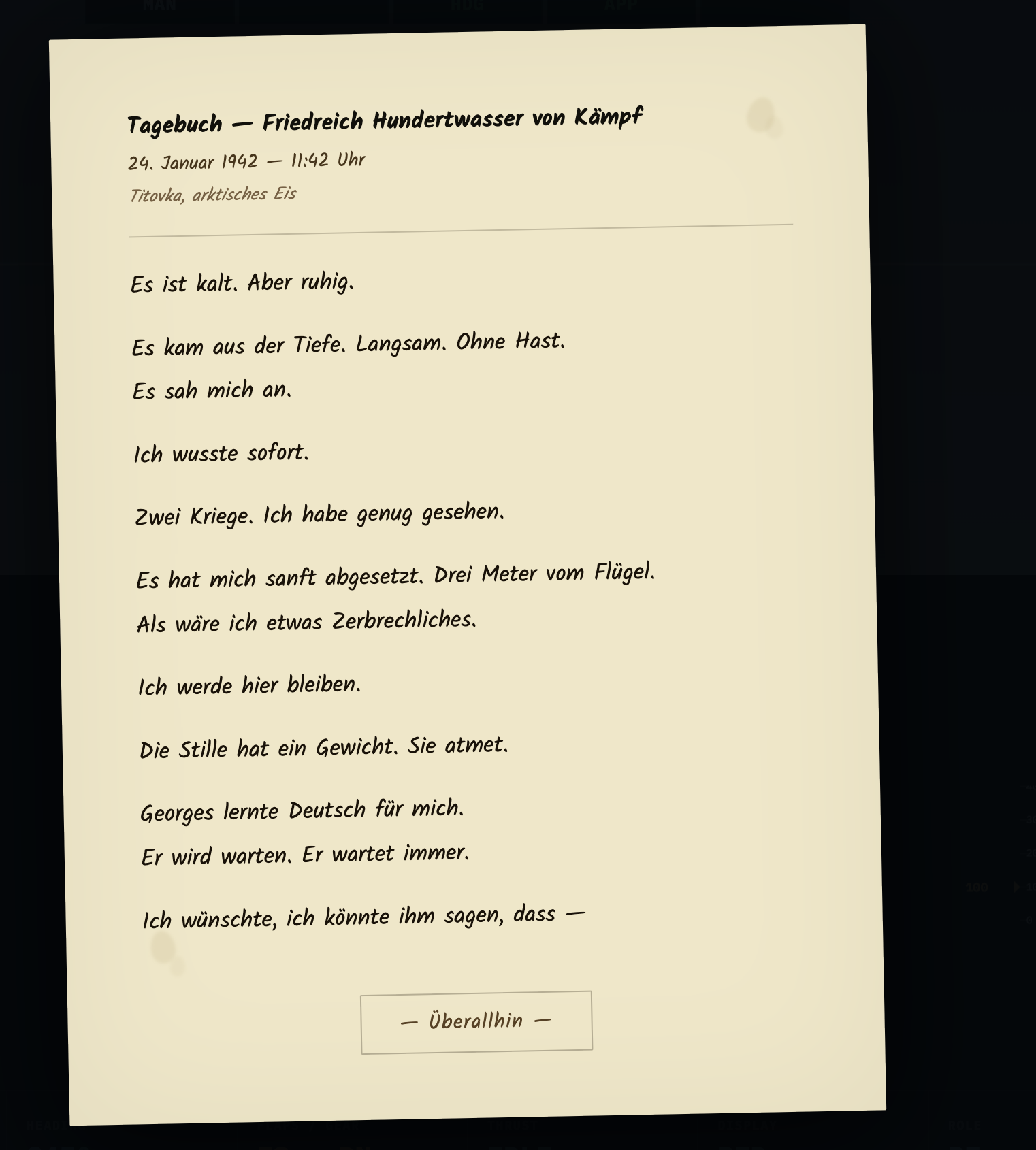
He opened the diary.
Wrote.
The letters grew smaller after the third sentence. The fingers no longer quite obeyed.
It is cold. But quiet.
It came from the depths. Slowly. Unhurried.
It looked at me.
I knew immediately.
Two wars. I have seen enough.
It set me down gently. Three metres from the wing. As if I were something fragile.
I will stay here.
The silence has a weight. It breathes.
Georges learned German for me.
He will wait. He always waits.
I wish I could tell him that —
The warmth came.
The false kind — but Friedrich took it as a gift. The body always lies kindly at the end. He had not known that. Now he knew.
He let the diary sink.
Lay back in the snow.
Not surrender. Trust.
He let himself fall deeper.
The silence breathed.
He breathed with it.
Once more.
In Petsamo, in a file on a desk, a stamp was waiting.
Concluded.
Georges would wait.
He would always wait.
G E N E V A
Spring 1942
René was two years old.
He did not yet understand sentences. But he understood bodies.
He understood that his father was different than before. Not sick. Not angry. Simply — less. As if a part of him were somewhere else. As if Georges woke each morning and first searched for something that was not there.
René did not know what.
He only knew: something was missing. And he could not fill it.
So he was silent too.
Georges got up early every morning.
Not because he had slept well. Because lying down was unbearable — the silence of the early morning that was too loud for a man waiting for a sound. A letter. A call. Anything.
Nothing came.
The war sent news. Sometimes. Telegrams with black borders. Forms with stamps.
Georges had not received a telegram.
That was the worst of it.
A telegram would have been an ending. A date. A place. Somewhere in Russia — yes. But somewhere.
Instead: nothing.
Friedrich had simply — not come back.
Klara asked once.
Only once.
Georges looked at her. A long time. With the eyes of a man who knows the answer but has no words that could carry it.
Then he said:
And that was true. And also not true.
Klara nodded. Never asked again. That was her way of loving — letting the other carry what he had to carry. Not taking it away. Not pressing. Just: being there.
She was always there.
Until she was not.
René grew up in a house that functioned.
Everything was there — food, warmth, order. Georges was precise. Reliable. The kind of man to whom you entrust the most important documents of your life.
And yet.
In the evenings, when Georges thought René was already asleep — he sat at the table. With a glass. With nothing in it but silence.
René did not always sleep.
He looked through the gap in the door.
He saw his father sitting — upright, still, hands flat on the table — looking at something that was not in the room.
René learned early: some things you do not ask about.
Some doors you leave closed.
Nineteen ninety-three. Georges died.
Alone. Klara was already gone.
He had never learned what had happened to Friedrich.
Fifty-one years.
On the nightstand — no letter. No photograph. Nothing pointing to Friedrich.
Only a small notebook. Empty except for the first page.
Three words. In a handwriting that was old and trembling.
René inherited the notebook.
He did not understand it.
He put it in a shoebox.
Together with a letter he had never sent. Not to his son. To Georges.
The question he could never ask while Georges was alive:
No name in it. No Friedrich.
Only the question about the silence itself.
G E N E V A · 1 9 1 9
Summer 1919
The pilot wore a white scarf.
That was the first thing Georges saw — not the aircraft, not the altitude, not the audacity of it all. But the scarf. White. Fluttering. Thirty metres above the ground.
The barnstormers had been in Geneva for a week.
Europe was breathing again. Carefully. The mistrust still sat in the shoulders of the men on the field — the kind of mistrust that forms when you have lost too much for too long. But the machines were flying. And when machines fly, people look up.
Georges looked up.
The pilot turned a wide curve over the field. Slowly. Precisely. As if he had time. As if the air were his home and not a place one crosses.
Then he saw Georges.
And waved.
Georges waved back. Instinctively. Without thinking. His hand rose before his head had decided.
Thirty metres of air between two people. A gesture.
That was the beginning of everything.
The bar had a name that appeared on a sign someone had fixed badly and that swung in the wind.
Georges found it by chance. Or by the white scarf — he had seen it from a distance, through the window.
He went in.
The pilot sat alone at a table. The scarf still around his neck. He wore it indoors too — not from cold. From habit. Or because it was part of him the way the wings were part of the machine.
Georges stopped.
The man looked up. Direct. The eyes of someone accustomed to measuring distance — not between people, between things. Between himself and the horizon.
He laughed.
Answered in German.
Georges understood nothing.
But he understood the laughter.
He sat down.
They ordered two beers. With gestures. With hands. With the universal vocabulary of people who want to say something and do not have the words.
Friedrich — Georges learned the name only later, piece by piece, in the slow German he acquired the way one acquires a new landscape: first the broad shapes, then the details — was Prussian. Georges did not notice this immediately. He only noticed: this man looks at the world the way I look at the world.
From above.
With distance.
Not as arrogance. As longing.
Georges learned German.
Not for school. Not for work.
For Friedrich.
It took two years. He bought books. He wrote letters in German that he did not send until he was sure they were right. He asked strangers for corrections. He listened when Germans spoke and tried to hear the music of the language before he understood the words.
Friedrich wrote to him in German. Always in German. Never in French — not from arrogance, but because he wanted to give Georges something: proof that it was worth it. That someone was waiting on the other side of the language.
Georges wrote back. At first haltingly. Then better. Then — at some point — in a German that made Friedrich laugh. Not from mockery. From joy.
Georges understood it as a compliment.
It was one.
The nineteen twenties.
They met when Friedrich flew through Switzerland — airshows, the brief glittering time when the air was still free and the money still flowed and Europe still believed that the last war had truly been the last.
They sat in bars and talked. About machines. About the air. About the specific quality of the silence that exists above a certain altitude.
About everything except politics.
Not from cowardice. Because it did not matter. Because two people who love the same thing need no borders to know who they are.
Nineteen twenty-nine. The crash.
Nineteen thirty-three. The cold returned.
The letters became rarer. The words more careful. The censorship sat between the lines like someone listening without being invited.
Friedrich wrote less. But he wrote.
Until nineteen thirty-nine.
Then: silence.
Georges waited.
He had always waited. That was his way of loving — quietly, patiently, hands flat on the table.
He waited for a letter that did not come.
For a telegram that did not come.
For anything that came and would tell him: this is how it was. This is how it ended.
Nothing came.
Only the silence that grew heavier with each year.
And René, looking through the gap in the door, not asking.
C I T Y H O S P I T A L
February 2000
I remember the sounds.
Beeping. Steady. The breathing machine. Tubes. Cables. Technology taking over what the body could no longer do alone.
René lay in the middle of it all.
So small.
I stood in the doorway and looked.
I was twenty-seven and I did not know what I was supposed to feel. I waited for something — grief, anger, love, anything that would tell me what to do now.
Nothing came.
I sat down on the chair beside the bed.
Looked at him.
Said nothing.
At some point I stood up.
And left.
Two weeks later. At work. A call.
My boss sent me home.
I went.
Empty.
No drama. Simply nothing.
— Everywhere —